Furniture · Platform Bed Frames
Slat Spacing and Support: Comparing The Clean Bedroom and Savvy Rest Frames
A bed frame can look quiet and simple while doing an essential job: holding a mattress evenly, day after day. The Clean Bedroom Taconic and Savvy Rest Afton both use wood slats, but differ in their stated spacing, materials, construction details and finishes. Understanding those distinctions—and checking them against your mattress maker’s requirements—can help you decide which frame is a better fit for your room and sleeping setup.
Published October 20, 2026
The small measurement with a big job
Slats rarely command attention when a bed is made. They sit beneath the mattress, out of sight, doing their work without ceremony. Yet the distance between them matters. A mattress rests on the frame, and the frame’s support system helps determine whether that surface is held consistently across its width and length. Slat spacing can also affect how much open space remains beneath the mattress for air to circulate.
That makes the support structure more than a detail to skim in a product description. A frame may suit a room beautifully and still be the wrong match for a particular mattress if its foundation does not meet the mattress manufacturer’s specifications. Conversely, a straightforward platform frame can be an effective choice when its construction, dimensions and support pattern align with the intended mattress.
The Clean Bedroom Taconic and Savvy Rest Afton are both wood platform frames, but their published details are not identical. The Taconic has solid wood slats positioned no more than 2.5 inches apart. The Afton uses closely spaced poplar slats, described as 3 inches wide and about 3 inches apart. That second figure should not be treated as a precise measurement of the open gap between slats unless the manufacturer defines it that way. Slat width and slat-to-slat spacing are different things; for a mattress decision, confirm the exact gap and the mattress maker’s accepted limit.
Here, then, is a comparison of the two frames as practical foundations—not a contest with a universal winner. The right choice depends on the mattress, the room, the materials and finishes you prefer, and the details that matter in everyday use.
At a glance: Taconic and Afton
| Feature | The Clean Bedroom Taconic | Savvy Rest Afton |
|---|---|---|
| Slat details | Solid wood slats spaced no more than 2.5 inches apart | Closely spaced poplar slats; listed as 3 inches wide and about 3 inches apart |
| Frame materials | Handcrafted in the USA from reclaimed wood, according to the product description | Maple rails and legs; poplar slats |
| Finish information | Non-toxic, water-based finish; listed options include Rustic Raw, Smooth Natural and Double Espresso | Hand-rubbed linseed oil, unfinished, or selected stains; finishes are described as zero-VOC |
| Additional construction details | Solid slats intended to provide a stable foundation and airflow | Five-point support system and solid steel, mortised-in corner brackets |
| Practical details | Check current size, assembly and support specifications with the seller | Listed for up to 750 pounds, with 12 inches of under-bed clearance and tool-free assembly |
Product specifications can change. Confirm current measurements, finish options, assembly instructions and weight limits with the manufacturer or seller before ordering.
Why slat spacing matters
Slats create a series of support points beneath a mattress. When they are placed closer together, the mattress has less open space between those supports. Wider gaps leave more of the underside unsupported by a slat at any given point. The consequences depend on the mattress design and its stated foundation requirements; there is no single spacing figure that can be assumed to work for every mattress.
That is especially important with foam and hybrid mattresses, whose manufacturers may specify a particular foundation type or maximum distance between slats. A frame that appears sturdy is not automatically compatible. Nor is a denser slat arrangement a substitute for checking the mattress warranty or care guide. Start with the mattress documentation, then compare its requirements with the frame’s specifications.
Airflow is another part of the conversation. A slatted platform leaves open areas beneath the mattress, unlike a fully solid surface. Both frames discussed here use slats, but airflow is influenced by more than spacing alone: the overall construction, room conditions and bedding all play a role. Open space can support circulation under the mattress, but it is not a promise against moisture, nor does it remove the need to follow the mattress maker’s maintenance advice.
Finally, spacing is only one piece of support. The frame needs to be assembled correctly, sit level, and have the appropriate center or perimeter support for its size and intended load. The dimensions and structure of the rails, legs and joints matter too. A useful comparison looks at the whole foundation rather than treating one measurement as a complete verdict.
The Clean Bedroom Taconic: reclaimed wood and close spacing
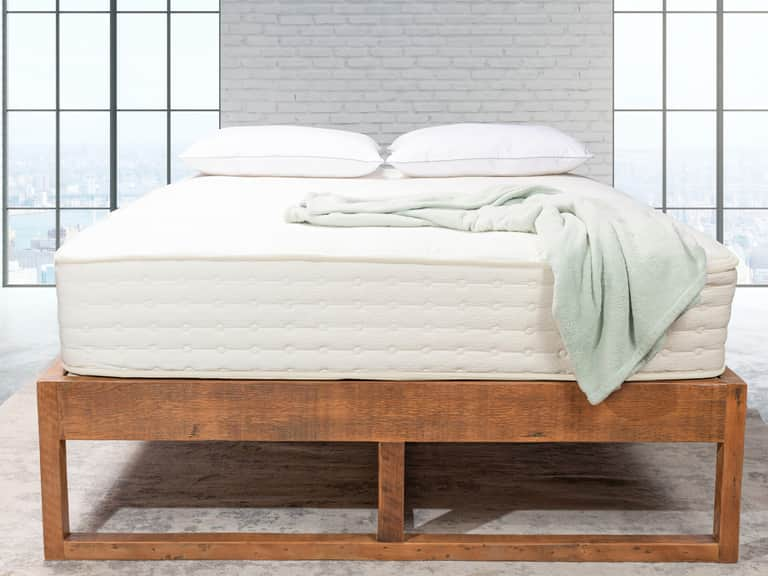
The Clean Bedroom Taconic Bed combines a minimalist platform design with reclaimed wood construction. Its listed slats are solid wood and spaced no more than 2.5 inches apart. That is the clearer of the two published spacing descriptions, and it gives shoppers a concrete number to compare with a mattress manufacturer’s maximum-gap guidance.
The frame’s description emphasizes a simple profile and a handcrafted-in-the-USA origin. It also identifies a non-toxic, water-based finish and describes the reclaimed wood as an eco-conscious material choice. Listed finishes include Rustic Raw, which retains a more rustic patina; Smooth Natural, which highlights the wood; and Double Espresso. Finish names and availability should be confirmed at the time of purchase, especially if the bed needs to coordinate with existing furniture.
The Taconic’s appeal is partly visual: reclaimed wood can bring variation and character to a room, while a clean-lined platform silhouette tends to work across a range of interiors. But the more practical question comes first. Does the frame’s slat arrangement meet the mattress requirements? The “no more than 2.5 inches” specification offers a useful starting point, but buyers should still verify what that measurement refers to and whether the mattress maker’s rules are stated as a maximum clear gap, a center-to-center distance, or another measure.
As with any wooden frame, inspect the assembly instructions and make sure each component is seated as intended. A support system’s stated spacing only helps if the slats are installed correctly and the frame is stable on the floor. If the bed will be placed on an uneven surface or moved often, ask the seller how the frame should be set up and maintained.
The Taconic may be worth investigating for shoppers who value reclaimed wood, a water-based finish and a relatively close stated slat interval. Those preferences do not by themselves establish compatibility with a specific mattress; the product and mattress specifications still need to meet.
The Savvy Rest Afton: maple rails, poplar slats
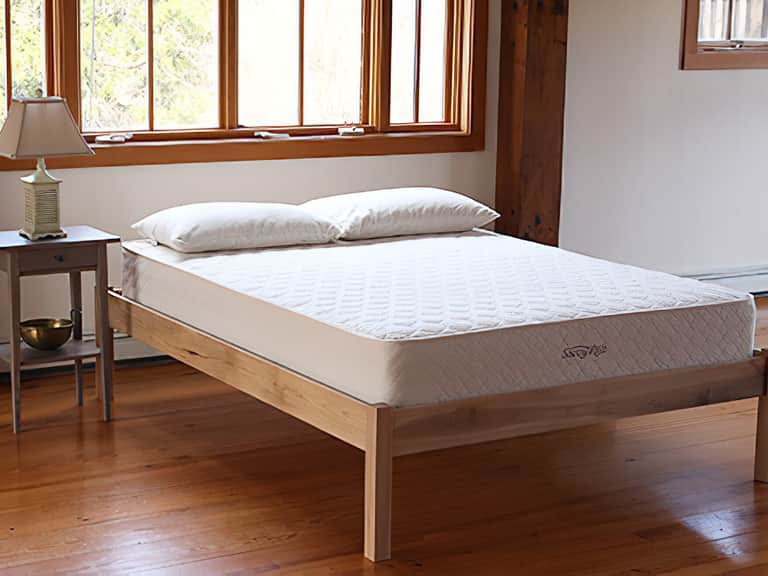
The Savvy Rest Afton Platform Bed takes a different materials-and-construction route. Its rails and legs are maple, while its slats are poplar. The product details describe a five-point support system and solid steel, mortised-in corner brackets—features that give shoppers more information about how the frame is reinforced beyond the slats themselves.
The listed slats are 3 inches wide and about 3 inches apart. That wording deserves careful reading. A slat’s width is not the same as the open gap between adjacent slats, and “about 3 inches apart” may need clarification before it is compared with a mattress warranty. Ask the seller for the actual clear distance between slats, or for a drawing or measurement method, if the mattress manufacturer gives a strict maximum gap.
The Afton is offered with a hand-rubbed linseed oil finish, an unfinished option, or selected stains, according to the product description. Its finishes are described as zero-VOC. The natural-finish emphasis may appeal to shoppers looking for a simple hardwood bed frame, while the additional stain choices can offer more flexibility in a bedroom’s palette. A finish preference is personal, but so is maintenance: review care instructions and any applicable information about curing, cleaning or refinishing.
The published specifications add several practical points. The frame has no headboard; the listed bed height is 16 inches from the floor to the top of the slats; and under-bed clearance is 12 inches. The product information gives a weight limit of up to 750 pounds and describes assembly as simple and tool-free. These particulars may be useful when planning a room, but they should be checked against current instructions and considered in context: total load, mattress size and how the bed is used all matter.
Size is another planning detail. The Afton specifications list twin, twin XL, full, queen, king and California king outer dimensions. Because the outer frame footprint is larger than the mattress itself, measure the room and account for walkways, doors, nightstands and any headboard or wall arrangement. The Afton is described as having no headboard, so anyone who wants one should establish whether a separate option can be used safely and how it attaches.
What the spacing comparison can—and cannot—tell you
On paper, the Taconic has the tighter stated maximum interval: no more than 2.5 inches. The Afton is described as using closely spaced slats about 3 inches apart. It may be tempting to declare the Taconic the better-supported frame on that basis alone. That would be too simple. The Afton’s spacing description is not fully precise about the measured gap, and support depends on the entire structure as well as the spacing.
More important, a narrower interval is not a universal measure of quality. It is one specification to match against a mattress. A mattress maker may set its own foundation requirements, and a frame that fails those requirements could create problems regardless of its finish, materials or appearance. If the required measurement is not stated in the frame listing, get clarification rather than assuming the numbers are directly comparable.
Nor do the available descriptions establish that either frame is quieter, more durable or more comfortable than the other in every bedroom. Construction details can inform a decision, but real-world results also depend on assembly, floor level, load, mattress type and upkeep. Treat product claims as specifications to verify, not as a substitute for fitting the frame to your particular use.
The comparison is most useful as a checklist. The Taconic offers reclaimed wood, solid slats and a stated maximum spacing. The Afton offers maple rails and legs, poplar slats, a five-point support system, steel corner brackets and additional published dimensions. Each description leaves questions that a careful buyer can resolve before ordering.
A practical decision process
Before choosing a platform frame, work through a few questions in order. This keeps the decision grounded in fit and function rather than turning a single material or measurement into a shortcut.
- Read the mattress requirements. Find the manufacturer’s instructions for foundations, slats and maximum allowable spacing. Check whether the rule refers to the clear opening between slats or another measurement.
- Confirm the frame measurement. For the Taconic, verify the stated “no more than 2.5 inches” detail and how it is measured. For the Afton, ask what “about 3 inches apart” means in terms of the actual gap.
- Check size and support needs. Match the frame to the mattress size, confirm any center-support requirements and compare the frame’s current weight limit with the expected total load.
- Plan the room footprint. Use outer dimensions, not mattress dimensions alone. Leave enough room for movement, doors, bedside furniture and bedding.
- Consider height and clearance. The Afton lists a 16-inch height to the top of the slats and 12 inches of under-bed clearance. Confirm comparable details for the Taconic if storage or a particular bed height matters.
- Review material and finish information. Compare reclaimed wood and water-based finish details with the Afton’s maple and poplar construction and listed finish choices. Ask about care and any finish-specific instructions.
- Confirm assembly and delivery details. Understand what arrives, what assembly involves, and whether the frame can be maneuvered through stairs, hallways and doorways.
These steps are particularly useful when buying a mattress and frame separately. A coordinated set may simplify compatibility questions, but independent purchases can work well when specifications are checked in advance. Keep copies of product documentation and warranty terms so that the basis for the choice is clear later.
Materials, finishes and the feel of a room
Once compatibility is settled, aesthetics can take a larger role. The Taconic’s reclaimed wood gives it a story of reuse and natural variation. The listed finish choices range from a rustic appearance to smoother or darker tones. That variation may be part of the appeal, though shoppers who want a highly uniform finish should ask what to expect from reclaimed material and whether the chosen finish has a sample or description available.
The Afton presents a different visual vocabulary: maple rails and legs, poplar slats, and options that include a hand-rubbed linseed oil finish or an unfinished surface. Its simple form may fit a bedroom where the bed is meant to recede rather than dominate. Stains are listed as additional options, so confirm current availability and any extra cost directly with the seller.
Neither frame’s finish should be judged by a label alone. “Water-based” and “zero-VOC” describe product information, but buyers with particular sensitivities or indoor-air concerns may want to request current documentation and follow the manufacturer’s care guidance. Material transparency is useful; it is not a replacement for asking a specific question about the product being delivered.
Room planning also includes the space under the bed. The Afton’s listed 12-inch clearance can help determine whether low-profile storage containers will fit, but the actual usable space may vary with floor conditions and frame setup. For the Taconic, check its current clearance dimensions rather than inferring them from the platform style. A frame’s footprint, finish and storage access should all work together in the room.
A note on care and long-term support
Wood frames are not maintenance-free simply because their construction is straightforward. Follow the manufacturer’s assembly and care instructions, and periodically check that fasteners and joints remain secure. If a frame develops movement or a sound, first confirm that it is level and correctly assembled; do not assume that adding an improvised brace is appropriate. Ask the manufacturer or seller for guidance before altering the support system.
Keep the mattress requirements in view throughout the life of the bed. Replacing a mattress can change the compatibility equation, even if the frame remains in good condition. A new mattress may have different foundation rules, dimensions or weight characteristics. Before placing it on an existing platform, verify that the slat layout and frame support still meet the new product’s specifications.
Air circulation beneath a mattress is also part of ordinary care, not a guarantee of a particular health outcome. Keep the bedroom reasonably ventilated, follow the mattress maker’s cleaning and rotation instructions, and investigate persistent moisture or musty odors rather than relying on slat spacing alone to solve them.
The bottom line
The Clean Bedroom Taconic and Savvy Rest Afton share a basic idea: a platform frame can support a mattress with a wood-slat foundation, avoiding the need to assume that every setup requires a separate box spring. Their details, however, point to different priorities. The Taconic emphasizes reclaimed wood, a water-based finish and solid slats spaced no more than 2.5 inches apart. The Afton specifies maple rails and legs, poplar slats, a five-point support system, steel corner brackets, finish options and practical dimensions.
If your first concern is a clearly stated close slat interval, the Taconic’s published maximum offers a useful reference point. If you are weighing wood species, reinforcement details, clearance or finish choices, the Afton provides a different set of specifications to assess. Neither description alone settles the question of which frame is right for a particular mattress.
The decisive move is a modest one: compare the mattress’s foundation requirements with the frame’s exact measurements, then confirm any ambiguity with the seller. After that, weigh construction, material preferences, bed height, room footprint and care. A good frame is not simply the one with the most persuasive feature list. It is the one whose support system fits the mattress, whose dimensions fit the room and whose materials make sense for the person living with it.